


Not every job that sounds like a great career actually is.
Some jobs look shiny from the outside: steady paychecks, solid benefits, a big company name. Your family thinks you’ve “made it.” But a few years later, you realize you’re doing the same thing for the same pay, and no clear way up.
That’s the quiet truth about dead-end jobs that look like dream careers. And the U.S. labor market has quite a few of them — jobs that used to be reliable, respectable, or even “safe bets,” but have quietly become traps for people who don’t keep an eye on where things are heading.

1. Retail Store & Customer Service Jobs
Why people think it’s a great career:
Retail and customer service are often seen as a “solid start.” You get real-world experience, learn to deal with people, and can move up to store or regional management.
The hidden truth:
- The U.S. Bureau of Labor Statistics (BLS) projects little to no growth in retail sales jobs from 2022 to 2032 — in fact, the sector is expected to lose about 338,000 jobs over the decade due to automation, e-commerce, and self-checkouts.
- Meanwhile, median pay for retail sales workers is only $32,000 per year (2023 data), well below the U.S. median wage of around $48,000.
- Promotion opportunities are shrinking: only a small percentage make it from floor staff to management, as companies streamline middle management roles.
So while it’s a good entry job, it’s rarely a good destination. Most people who stay too long find themselves surrounded by low pay and few transferable skills.
When it’s not a dead end:
If you treat it as a stepping stone — learning analytics, merchandising, or e-commerce tools — it can open doors to roles like category management, retail operations, or digital marketing. But don’t rely on the store ladder alone.
2. Administrative or Clerical Roles
Administrative assistants, receptionists, and office clerks are often considered “safe” jobs. They’re common in every industry, usually full-time, and have clear routines.
The real fact:
These roles have been badly affected by automation and AI.
- The BLS projects that administrative assistant and office clerk roles will decline by about 10–12% over the next decade.
- AI scheduling, automated workflows, and chat-based customer support are replacing many traditional tasks.
- Many companies are consolidating admin roles — one person doing what three used to.
When it’s not a dead end:
Use the position to learn project management, digital tools (like Excel, Notion, or CRM software), or executive coordination. That can move you toward operations, HR, or program management.
3. Call Center & Customer Support Jobs
Why people think it’s great:
Decent pay, benefits, structured career ladders, and a clear corporate environment — sounds like a good deal. Plus, these jobs teach communication and conflict resolution.
The flip side:
Customer support is one of the most rapidly automating fields in the U.S.
- According to McKinsey, up to 45% of customer service tasks are automatable with current technology.
- Companies like Amazon, American Airlines, and Comcast have scaled back live support roles in favor of chatbots and self-service platforms.
- The BLS projects only 3% growth in customer service roles over 10 years — far slower than the national average of 5%.
So while it might start with solid pay, the ceiling is low. Many people stay too long, hoping to move into management, but those openings are rare and highly competitive.
4. Middle Management in Legacy Corporations
Why people think it’s great:
Middle management used to be the gold standard — you weren’t at the bottom, you had a title, a team, and stability.
The harsh reality:
Corporate structures are flattening. Fewer layers of management mean fewer promotions — and more burnout.
- A 2023 Deloitte report found that over 60% of mid-level managers feel “stuck” in their roles with limited upward mobility.
- Many large U.S. companies (from Google to AT&T) have reduced middle management layers, pushing managers to oversee larger teams or handle more technical work.
When it’s not a dead end:
Middle management can be a platform — if you build cross-functional skills like data literacy, leadership, and change management. Those who pivot to strategy, operations, or consulting can still thrive.
5. Niche Technical Roles (Tool-Based Specialists)
This means that you’re working with specialized tools like Salesforce, ServiceNow, or Excel-based automation. It feels like the most futuristic thing to do.
The bitter truth:
Being a “tool specialist” without broader technical or business context can cap your growth.
- The World Economic Forum’s Future of Jobs Report (2023) found that 44% of workers’ skills will be disrupted within five years — meaning, if you’re tied to one tool or platform, you’re vulnerable.
- Many companies now prefer “full-stack” professionals who can work across systems, not single-tool experts.

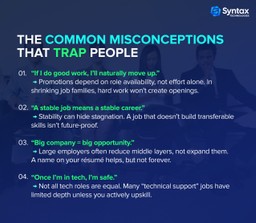
How to Avoid Dead-End Jobs
1. Ask better questions during interviews.
- “What’s the typical career path from this role?”
- “How long do people usually stay before promotion?”
- “What new skills will I learn here in the first 12 months?”
2. Focus on skill growth, not job titles.
The most valuable employees aren’t the ones who’ve just stayed in a job for five years — they’re the ones who’ve kept learning and growing each year.
3. Re-skill before you need to.
AI, automation, and digital transformation are changing every industry. The best move is to keep learning — especially in data, digital tools, and communication.
4. Have a 2-year check-in rule.
Every two years, ask yourself: “Am I learning, earning, or growing?” If the answer is no to all three, it’s time to pivot.
Final Thought
The biggest trap isn’t taking a dead-end job — it’s staying in one without realizing it.
In today’s U.S. job market, roles like retail, customer support, admin work, or narrow technical jobs still matter — but they’re no longer automatic gateways to a long career. The key is to treat them as stepping stones, not destinations. If your job doesn’t build skills, network, or upward momentum, you’re standing still while the market moves forward.